


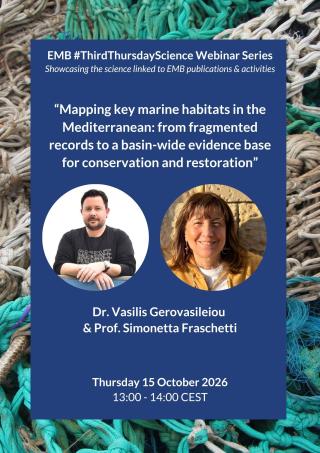
This webinar links to EMB Future Science Brief No. 11 "Marine habitat mapping".
Vasilis Gerovasileiou is Associate Professor of Marine and Coastal Biodiversity at the Department of Environment, Ionian University, Greece, and Collaborative University Faculty at the Hellenic Centre for Marine Research (HCMR). His research focuses on marine biodiversity, benthic ecology, habitat mapping, biological invasions, conservation and restoration, with particular emphasis on key and vulnerable marine habitats. He has participated in more than 60 national and international research projects and environmental studies, including as Principal Investigator, scientific coordinator and Work Package Leader, collaborating with universities, research centres, Marine Protected Areas, NGOs and international organizations. His work integrates biodiversity research, habitat mapping and ecological monitoring to strengthen the evidence base for marine conservation, restoration and management and to support the science–policy interface. He has contributed to regional and international conservation initiatives in collaboration with UNEP/MAP-SPA/RAC, IUCN and FAO/GFCM, including biodiversity assessments, monitoring approaches and conservation guidelines. Recent work has focused on integrating fragmented spatial information on Mediterranean key marine habitats into basin-wide evidence bases for conservation and restoration. He is Co-Editor-in-Chief of Mediterranean Marine Science and Coordinator and Founding Editor of the World Register of Marine Cave Species (WoRCS), part of the World Register of Marine Species (WoRMS).
Simonetta Fraschetti is Full Professor of Ecology at the University of Naples Federico II. She is Co-Chair of the European marine science network EuroMarine. Awarded the Tridente d’Oro for Scientific Activities in 2023, she has served as Co-Leader of Spoke 1 of the National Biodiversity Future Center, President of the European Marine Biology Symposium (EMBS), Chair of the European Marine Board Working Group on Marine Habitat Mapping, and member of the Board of Directors of the Stazione Zoologica Anton Dohrn. Her research combines descriptive field studies, manipulative experiments, habitat mapping and spatial analysis to investigate patterns of marine biodiversity and quantify changes driven by multiple pressures, with the broader goal of translating ecological knowledge into effective conservation, restoration and management strategies. She is involved in numerous national and international projects focusing on the design and assessment of marine protected areas and other area-based conservation measures, including their ecological effectiveness in reducing the impacts of human activities. Her work also contributes to developing the scientific knowledge, experimental approaches, methodologies and best practices needed to support the restoration of degraded marine species and habitats. A further major focus is the integration of biodiversity conservation and restoration into marine spatial planning, defining criteria and priorities for ecologically effective conservation networks while promoting the sustainable use of marine space.
You can re-watch the webinar on the EMB YouTube Channel, and download the slides from Prof. Frascehetti here, and Dr. Gerovasileiou here.