


Comprehensive biodiversity assessments are critical to support effective marine ecosystem-based management. This is particularly relevant for implementing the BBNJ Agreement, as well as European Directives including the MSFD, Nature Restoration Regulation and the 2030 Biodiversity Strategy.
Biomolecular tools include -omics and eDNA, and are increasingly important for Ocean observations, known as ‘augmented observatories’ when combined with traditional tools. These provide high-resolution insights into biodiversity and ecosystems in support of conservation and ecosystem-based management. There is a need for scalable and reproducible biomolecular tools and metrics to establish reliable biological baselines, improve the scientific basis for monitoring protected species, provide early warning for pathogens, invasive species and harmful algal blooms, assess environmental impacts of human activities and climate change, and support conservation measures such as Marine Protected Areas.
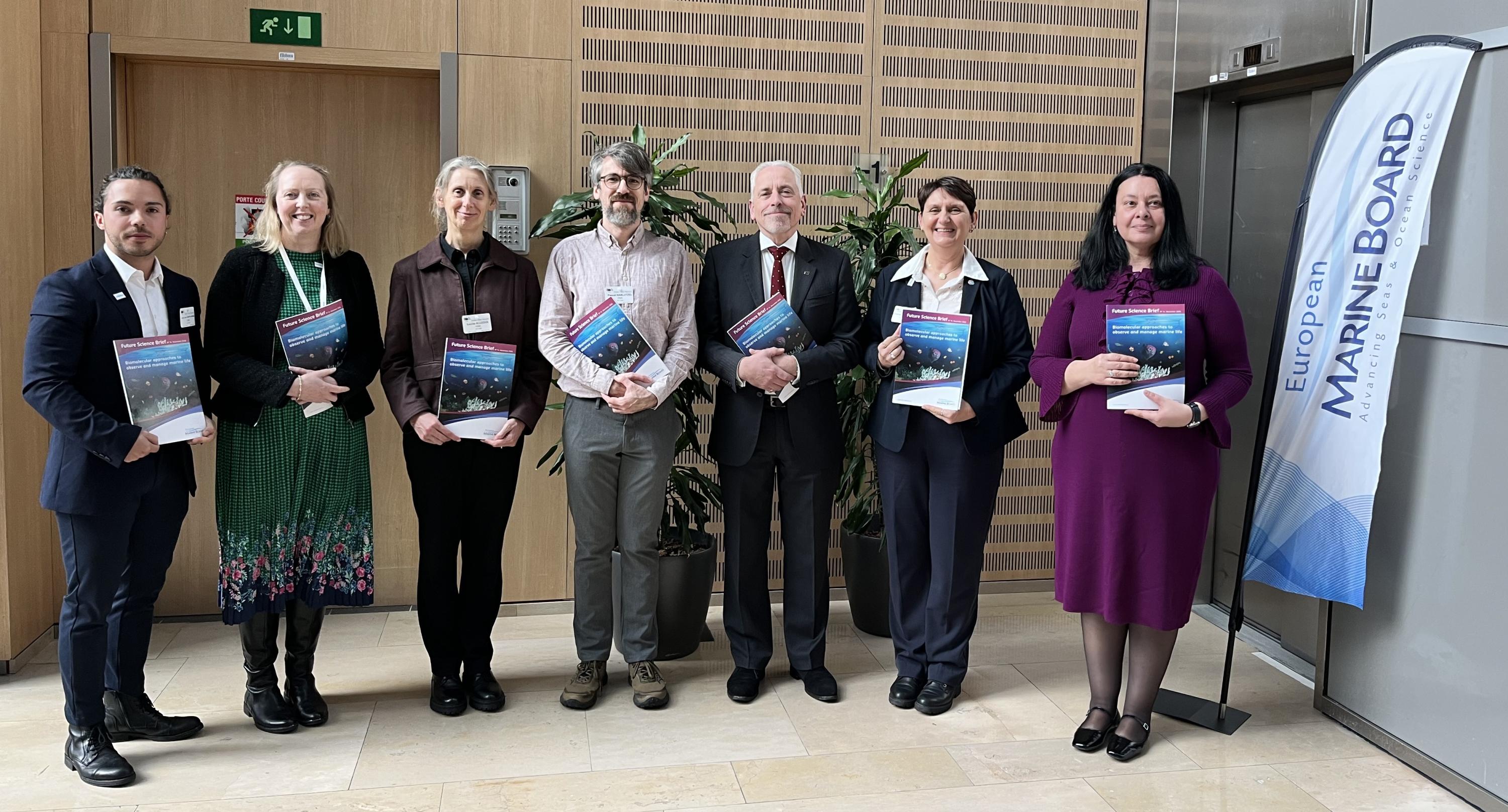
EMB Future Science Brief No. 14 provides recommendations for advancing and scaling up biomolecular tools to support marine management and policy for improved efficiency, accuracy and cost-effectiveness of marine monitoring. Research and innovation needs for scaling up automated and miniaturised biomolecular samplers and sensors are presented, providing important input to the EU OceanEye initiative. This will enable biological observations at increasing temporal, spatial and taxonomic resolution, generating high-resolution biological data to feed into Digital Twins of the Ocean. In order to scale up their use, biomolecular methods and data require operationalisation and standardisation, as well as the targeted expansion and improvement of molecular reference databases.
The document is authored by a Working Group consisting of 13 members from 11 countries, Chaired by Prof. Louise Allcock, Ryan Institute, University of Galway and Prof. Paloma Morán, University of Vigo, Spain.
The event was attended by diverse stakeholders from research and policy and featured a presentation of the document by the Working Group Chair, Prof. Louise Allcock. Responses were provided by James Morrison (Director of Healthy Planet at DG RTD), highlighting that "this document comes at a key time for the European Commission as we draft the upcoming Ocean and Water Research and Innovation Strategy and enter the next Framework Programme". Andreea Strachineascu (Head of Unit, Maritime Innovation, Knowledge and Investment, Directorate General for Maritime Affairs and Fisheries) provided final comments, highlighting that "we have the opportunity with the OceanEye initiative to make biomolecular tools a core pillar of Ocean observations, which have previously been a blindspot. These tools are ready to move to the next level to deliver knowledge and improve European competitiveness".
The event ended with an interactive discussion with the audience.
Prof. Allcock will also present the document at the World Conference on Marine Biodiversity in Brugge, Belgium on 19 November 2026.
Find out more about the Future Science Brief and download it here.
Find out more about the Brown Bag Lunch event here and watch the presentation on the EMB YouTube Channel.